
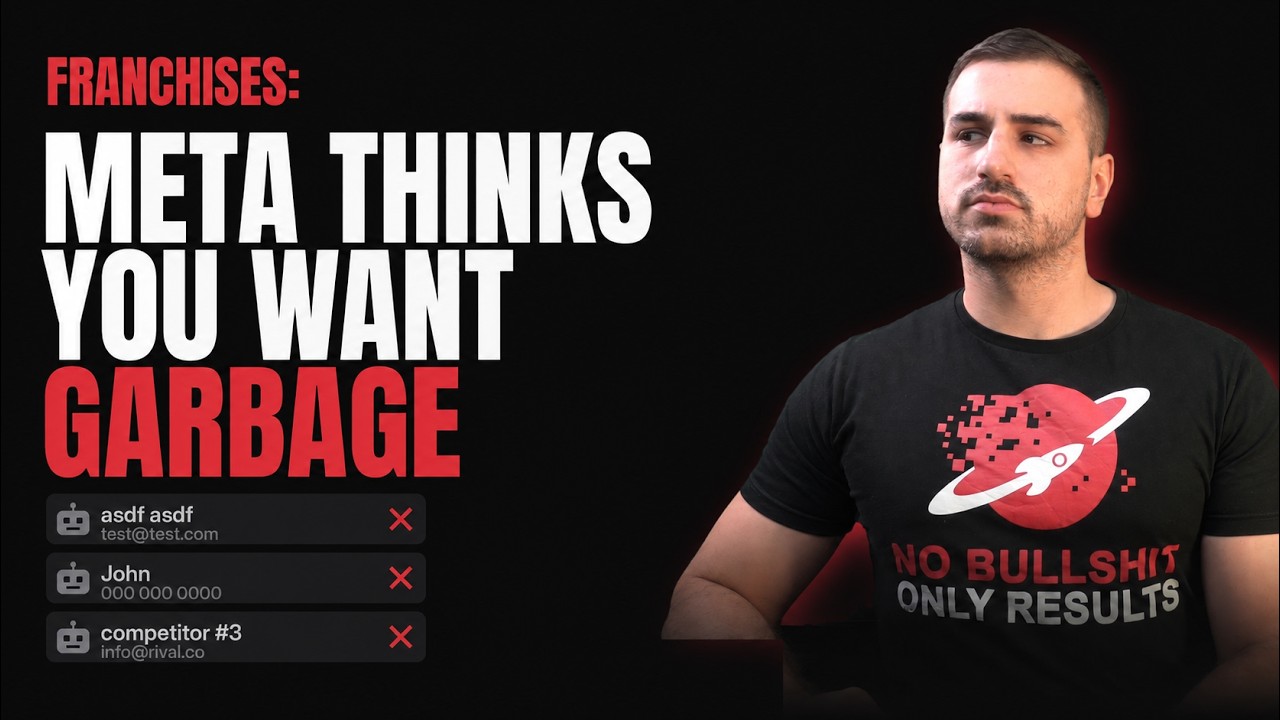
Why would a franchise make its own sign-up harder?
Ivan opens with a franchise that already has hundreds of people in its network, and still makes every new candidate go through a quiz instead of a simple sign-up form. A quiz costs more per lead and fewer people finish it, so on paper the business is cutting its own number of sign-ups on purpose.
The reason is who comes through a basic form. In Ivan's words, most of them are tire kickers. They are often fake, sometimes bots, and a lot of the time even competitors. Each one becomes another contact in your CRM that is never going to pick up the phone.
Making the funnel longer has a clear upside: it filters out the bots and the window shoppers. It also has a cost. It is one more hurdle, and some people who should not be there will still get through and still waste your sales team's time. The goal is not a perfect filter. It is to stop tire kickers from eating resources on questions that are never going to turn into revenue.
How do you grade franchise leads Green, Amber or Red?
The fix Ivan's team uses starts with the ideal client profile. If you know the type of candidate you can sell to consistently, that candidate is Green. A candidate who is a reasonable fit but needs nurturing, more money or more time is Amber (Ivan calls it medium, or yellow, in the video). Everyone else is Red, because they will take up your team's time and never buy.
What is GAR lead grading?
GAR stands for Green, Amber, Red. Every lead is graded on arrival against your ideal client profile: Green leads can buy now and go straight to sales, Amber leads need nurturing, money or time, and Red leads are excluded.
How do bad leads train the ad algorithm?
Grading matters for more than your sales team. If your ads are optimizing for volume, every form fill counts as a success, whatever its quality. The more low-quality leads go through, the more the platform learns that this is what you want, and the more of them it sends.
I have 8 billion people that I can send you potentially. All of them equally uninterested.
Ivan's point about the example funnel is blunt: if that business launched ads on a basic form, the funnel would fill up with bots, and you would be paying to make the problem bigger.
Why do multi-step forms filter out tire kickers?
The second funnel in the video goes further. The first step looks like a normal form. Then a second, longer form takes real time to answer, then another, and another. It is labelled stage one, so there is more after it: three or four steps in total.
That is deliberately hard for the person filling it in. You have to be genuinely interested in buying a franchise to complete every step. It also separates two groups cleanly: people who only wanted more information, and people who actually finished the business assessment.
Why does a yes or no quiz still let the wrong people through?
A quiz sits in between: longer than a basic form, shorter than a full multi-step assessment. The weakness is the question type. If every question is yes or no, people mash through to the end without reading, and you get false positives: leads that look qualified and are not.
What is a false positive lead?
A false positive is a lead that looks qualified because it completed your form or quiz, but is not genuinely interested or able to buy. Yes or no questions make them easy to produce, because people can click through without reading.
Ivan's fix is to add questions that need a typed answer, with a minimum number of characters. Someone who has to write a few sentences cannot click their way into your sales calendar.
Option one: score the quiz and send only Green to Meta
Both tools work. The quiz and the multi-step form can each be implemented, and the right choice depends on what you want to anchor qualification to.
If your quiz gives points, set a minimum threshold:
- Above the threshold: Green.
- Under the threshold: Amber.
- Well under it: Red.
Then be careful with tracking. Do not fire your lead, registration or custom events on the pages Red candidates land on. If those events fire for everyone, Meta treats bad leads as successes and learns from bad examples. Limit what gets sent back to Meta as a positive result to the leads you actually want more of.
Option two: qualify on a common denominator
The simpler route is what Ivan calls the common denominator: one number every buyer has to meet. For the franchise in the video, candidates need upwards of 70K available to buy. If they do not have the money, it does not matter how much goodwill they have.
What is a common denominator in lead qualification?
A common denominator is one requirement every buyer must meet, such as the capital needed to buy the franchise. Leads are graded on that requirement first, so a candidate without it is Red however good the rest of their answers are.
So as candidates answer, you mark the two answers that matter, finances and readiness to move forward, and grade from those:
| Has the finances | Ready to move forward | Grade |
|---|---|---|
| Yes | Yes | Green |
| Yes | Not sure | Amber |
| No | Any answer | Red |
That one rule saves your team from spending time and money on tire kickers.
Why does speed to lead still matter after grading?
Grading only pays off if you act on it. When a serious candidate is looking at buying a franchise, others are trying to close them as fast as possible. If you take a couple of days to reach out, because your team was calling earlier applicants who turned out to be tire kickers, that candidate may already have bought from somebody else.
What should you change in your funnel now?
Ivan's closing advice is to look at your current funnel. If it is a basic form, either build a quiz with real questions or move to a multi-step process. Either way, stop teaching the algorithm that it is fine to bring you people who do not have the resources to buy a franchise.
- Write down what makes a candidate Green, Amber and Red for your system.
- Pick the anchor: a scored quiz, or one common denominator such as available capital.
- Add at least one question that needs a typed answer.
- Fire conversion events for Green only, and keep them off the pages Red candidates reach.
- Call Green candidates first, and fast.
Without tracking this, you will never know what worked, what did not, and where to put more money. For the wider list of what goes wrong in franchise recruitment, see the most common franchise recruitment marketing mistakes, or how we run franchise recruitment marketing.
Full video transcript
From the YouTube captions, lightly cleaned. Timestamps open that moment in the video.
Why a franchise would make sign-up harder
Why would an established franchise that has hundreds of people in their network use a quiz to filter people through? Why not just use a typical and regular form? Because you already know that the franchise quiz is going to cost a lot more money and have a lot less people going through the whole quiz compared to just the sign-up form. So, why is this business purposefully destroying their number of sign-ups?
Basic forms attract tire kickers
Well, it's simple because most of the people you get through a basic form like this is going to be tire kickers. Like they're just bad. They don't really know what the they're doing most of the time. They're often fake, sometimes bots, a lot of the times even competition. Does it value anything or is it just another contact that's never going to pick up? So, the solution to this is to make the funnel a lot longer. And yeah, that has plusses and has minuses. So, the the plusses are that you filter out all of the bots and all of the people that are window shopping if you make the funnel a lot longer. But at the same time, you do make it just another big hurdle and still there's a lot of people that are going to come through and still waste the time of your sales team. So, the point of doing something like this is to prevent tire kickers from wasting your resources and sales team on dumb questions that you know are never going to turn into any revenue.
Green, Amber, Red: define your ideal candidate
So, the solution that we often do is we quantify what we call our ICP or ideal client profile. So, if we know that we have a specific type of lead that we can sell to consistently, then that's perfect. We consider that green. If we have a lead that's okay, but it needs some nurturing or they need some money, need some time, that's medium or yellow. And then red is get the out of here. Because they're just going to spend all of our time. They're not going to help
How bad leads train the ad algorithm
us. And the other problem is that more people like that that go through our funnel, it's going to teach the algorithm that this is good. We need more. Because the problem is we're just launching ads and we're going for volume. And if you don't have green or any other quantification, then you're going for form fills or as many people as fill out this quiz or fill out the form. And the problem with that is you're just going to get a lot of them and it's not going to be by any type of quality. And the more low quality that go through, the harder the case because for example for this if these guys launch ads, they're going to get destroyed because the funnel's going to get filled out with bots and every time a bad lead fills out method just like, "Yeah, this guy's like garbage. I'll give you garbage. I have 8 billion people that I can send you potentially. All of them equally uninterested." So, the problem with that is that you are paying money to solve this problem. So, the problem with these guys is that they don't have
Multi-step forms that make people earn the call
anything besides this. The problem with these guys is that they This is the first step is the same and then you go to a second form that's even longer and it takes you a long time to answer. And then of course you have the second part of it when you fill this out, then you get to the second field. And this second field actually gets you to fill out a lot of information, then you get another field and you just keep on getting these and they string you along. And so basically what we get is a more multiple step system where we differentiate between people that just wanted more information and then people that actually completed the online business assessment form. And you can see it says stage one here. So, we have one even longer after this. So, you can imagine it's three or four different steps which make it super complicated for the end user. You really need to be interested in buying this if you're going to complete all of these steps.
Quizzes and the false positive problem
So, these guys are kind of in between. They built a quiz. It's longer than our forms, but our forms end up being insane and making all of the people go out. So, if the quizzes are all like just yes, no, da da da da da da, people are still going to mash until they go through this. So, the problem with this is that people are just going to click until they go through quickly and then you're going to have a lot of false positives. The quiz, especially set up like this, is not going to be able to give you high-quality leads simply because you're still letting the unqualified people through. So, adding to the quiz questions that they have to fill out a lot more text out of characters or a minimum characters so they actually have to type something out is going to then disable people from just like click click click click next and then somehow they get your sales team. And you need to understand, it's not just your sales team. Every time you have a false positive that's not really interested, you're stuck in the situation where you're going to pay
Option one: score the quiz, send only Green to Meta
fees of on pawn fees for them. So, the solution that I propose is one or the either. You can do the quiz, but the quiz needs to be with a lot more fields to ask questions and I would then do the quantification. So, the quiz can be implemented and the multiple step forms can be implemented. It really depends on what you want to anchor the qualification process to. So, if your quiz has points, what you can do is just have a minimum threshold. Above the threshold, they're green. Under the threshold, they're yellow. And even less, they're red. That way, you set up a green and red system and the whole point is you don't want that tracking of the Facebook page to be and you don't want to add the tracking systems or lead registration events, custom events, to the pages that are red because you don't want the meta algorithm to think that you have false positive and then woohoo Homer Simpson and it doesn't do anything because there's going to learn based on bad examples. So, you need to limit the data that gets sent back to meta as positive. That's the first
Option two: qualify on a common denominator
option. The second option is simplifying it. So, in a funnel like this, you need to have something that I call the common denominator. Common denominator meaning that we have a number in mind. So, these people all have to have northwards of 70K plus in order for them to buy this franchise. If they don't have the money, doesn't matter how much good will they have. So, as they answer questions, we mark the points where they talk about their finances and readiness to move forward. If they give us yes for finances and yes for readiness to move forward, they're green. If they give yes to just the finances but not sure they're ready to move, they get yellow, not sure. And then if they say no to finances, doesn't matter what they say about readiness, they're red. That way we save our team from actually spending money on tire kickers and
Speed to lead
resources. And again, speed to lead is super important, especially when you have a hundred candidates looking into buying a franchise. People are going to go after you and trying to close as fast as possible. And the fact that you took a couple of days to reach out to them and you called other people that applied first but were tire kickers and now they bought from somebody else, you get me.
What to change in your funnel now
So, a system like this is necessary for any modern franchise that wants to scale, especially if you want to use PPC. And if you want to scale with advertisement. Without tracking this, you're never actually going to be able to know what worked, what didn't, and where you need to invest more money. So, yeah, think about this next time you develop your funnel and look at your current funnel. If you're just running something like this, then look into either developing a quiz like these guys did or just making it a multiple process where you have a lot of these questions because again, you do not want to teach the algorithm that it's okay to bring you dumb asses that don't really have any resources to buy the franchise from you. And if you need any help expanding your franchise network, improving your lead quality, or helping your sales team, or get your sales team that commission they've been crying about for some time, you can find us at digitalrocket.com.